You’ve probably tried to coordinate internal training at some point, and you know it’s usually a headache. Between emails, spreadsheets, lost documents, and last-minute reminders, managing training can become a real obstacle course . And the worst part: all that effort often doesn’t translate into visible results.
The good news is that it doesn’t have to be this way. Training can and should be easy, strategic, and measurable. That’s where a Learning Management System ( LMS ) comes in: the platform that centralises, automates, and measures all corporate learning from a single location.
📚 An LMS not only digitises your training plan , it also helps ensure that every course, workshop, or webinar has a real impact on your team. The result? More learning, less hassle, and a culture of continuous improvement that’s noticeable every day.
We’ll tell you what an LMS is, why it’s transforming training in companies, and how you can start getting the most out of it without complicating your life.
Key data
- A Learning Management System (LMS) is a digital platform that centralises the planning, delivery, and evaluation of all corporate training in a single integrated system.
- According to the LinkedIn Workplace Learning Report 2025 , 88% of organisations consider talent retention a priority, and offering learning opportunities is the number one strategy to achieve it.
- According to SHRM, 53% of HR directors plan to increase investment in skills development to help staff adapt to AI, and only 21% of organisations believe they are doing so effectively.

What is an LMS?
An LMS is a learning management system . It’s a digital platform that allows you to plan, implement, and evaluate training processes within your company. In other words, an LMS helps you centralise all training in one place, from online courses to progress tracking. And this is where things get interesting: the key is the all-in-one approach .
Some key functions of an LMS:
- Create and assign custom courses.
- Track the progress of each employee.
- Integrate external content (videos, PDFs, links, etc.).
- Generate compliance and results reports.
- Ensure continuous and up-to-date training.
Sounds good, right? But this isn’t just about technology. The goal is to boost your teams’ learning in a simple, accessible, and strategic way.
Why does a training LMS transform corporate learning management?
Until recently, training was seen as an “extra,” something done only if there was spare time or budget. Today, professional development has become one of the keys to attracting, retaining, and motivating talent , especially in a constantly changing environment.
According to the LinkedIn Workplace Learning Report 2025, 88% of organisations cite talent retention as a top priority, and providing learning opportunities is the number one retention strategy.
Along the same lines, experts from the Future Forum (Santander and Cinco Días) point out:
The new challenge lies in identifying, developing, and retaining internal talent … Promoting internal talent increases productivity… significantly reduces turnover and absenteeism , which has a clear impact on business and productivity.
The data supports this urgency: according to SHRM, 33% of learning and development managers cite skills training as their number one priority for the coming year, and 53% of HR directors plan to increase investment in rapid skills development to help staff adapt to artificial intelligence.
If we haven’t yet given you enough reasons to convince you of how crucial it is to have a good LMS, here are a few more:
1. Scalability
Do you have teams distributed across different offices or with hybrid models? An LMS allows you to offer the same training experience to everyone , regardless of their location.
2. Saving time (and headaches)
With an LMS, you can automate reminders, assign courses by role or department, and get instant reports . No more uncontrolled or untraceable shared documents.
3. Actual monitoring and evaluation
Who has completed the mandatory risk prevention course? How many hours has your team dedicated to training this quarter? An LMS gives you clear and measurable answers.
4. Personalised learning experience
Each employee can access content that truly provides value , based on their interests, skills, or career development path.
5. Improvement of the learning culture
An environment where learning is easy, accessible and part of everyday life reinforces a culture of continuous improvement and professional growth.
What does Kenyan legislation say about in-company training?
In Kenya, employee training is more than a talent-development initiative. Employers are legally required to comply with the Industrial Training Levy framework administered by NITA, contributing KSh 50 per employee each month. Levy-compliant employers can also access reimbursement for eligible employee training costs, subject to NITA’s requirements.
This makes accurate training records and documentation essential. An LMS can centralise employee training, automatically recording who completed each course, when it was completed and the outcome. This creates a clear audit trail while making it easier for HR teams to manage training requirements and prepare documentation for NITA reimbursement claims.
NITA’s training reimbursement framework covers areas including skills upgrading, apprenticeships, learnerships and industrial attachment.
How do you know if your company needs a training LMS?
There are some signs that indicate the time has come to digitize training management:
- There are too many channels involved (emails, folders, documents, external tools…).
- You don’t know who has done what training or when .
- Mandatory training becomes difficult to control.
- Your HR team spends more time coordinating than adding value.
- There is no clear internal development strategy .
These symptoms are compounded by a specific legal risk: if your company cannot demonstrate during an inspection that it has provided the required training (occupational health and safety, equality, data protection), it risks penalties. A training LMS automatically generates the records and certificates necessary to prove regulatory compliance.
If you’ve identified with any (or several) of these situations, you’re not alone. And luckily, there’s a solution.
How to manage your LMS training programs from a single platform?
We know how important it is to have well-trained, up-to-date teams eager to grow. But we also know how complicated it can be to manage all that control without the right tool.
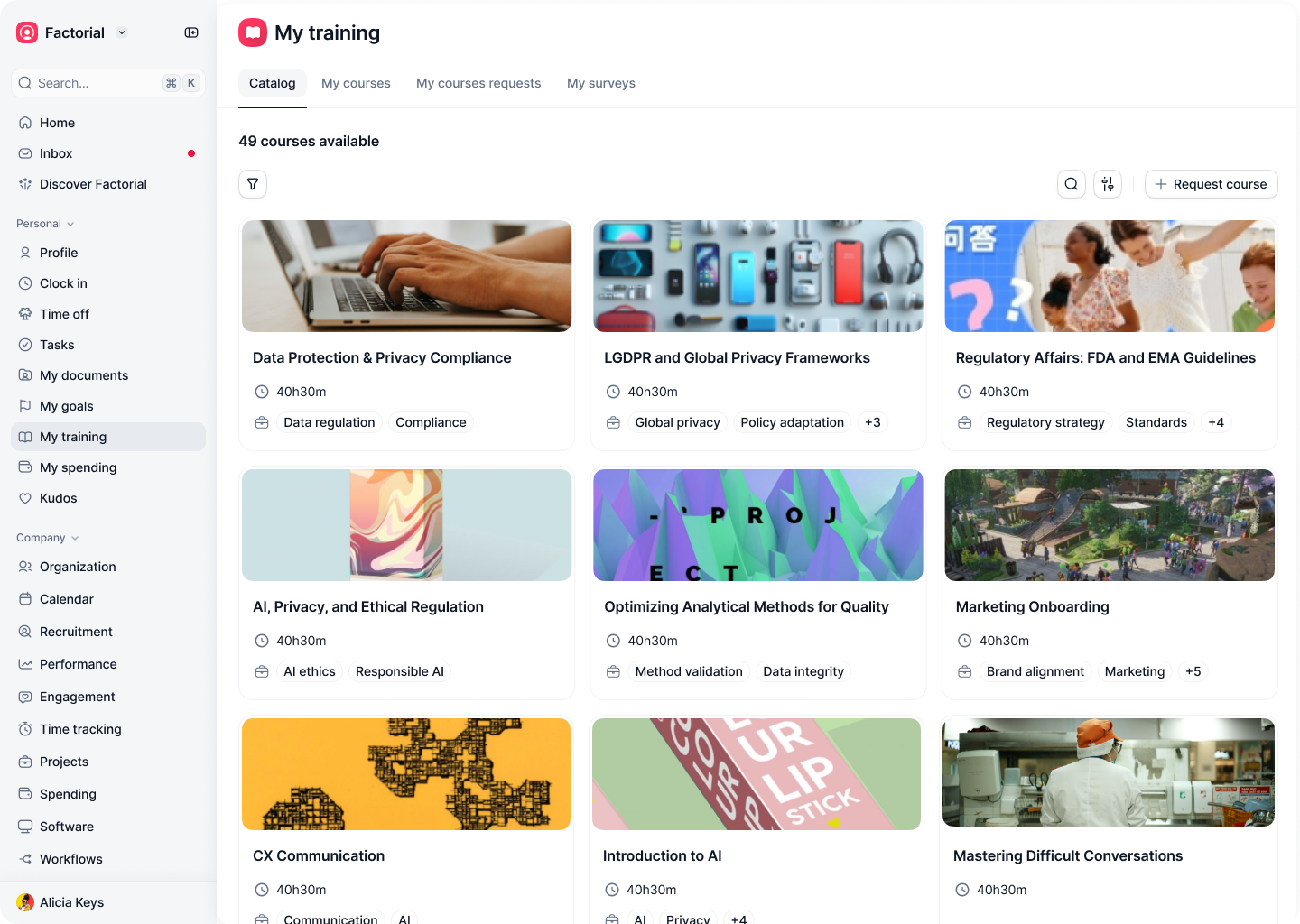
That’s why at Factorial we’ve designed a training management system fully integrated with the rest of your HR processes . We help you create, assign, and track any course , whether mandatory or for professional development, from a single platform and with the support of artificial intelligence .
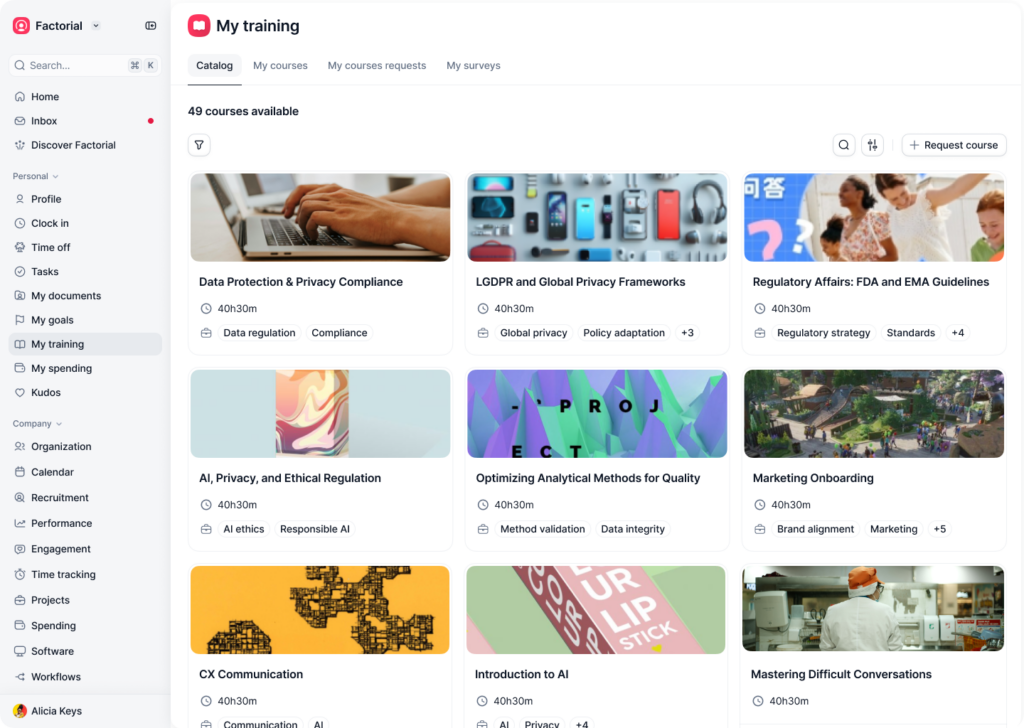
What can you do from our LMS?
- Design your own annual training plan , with full visibility of objectives, deadlines and progress.
- Create content with AI: describe what you need and Factorial’s AI generates structured courses from onboarding to regulatory compliance in minutes.
- Automatically assign courses based on departments, teams, or professional profiles.
- Upload any type of content (videos, PDFs, links…) or integrate external platforms.
- See who has completed what , when, and with what results.
- Comply with mandatory training regulations , with traceability and always up-to-date reports.
- Measure the impact of training and make strategic decisions based on the data.
And the best part: all of this is connected with the rest of the HR tools that are already part of Factorial , such as career plans, onboarding, performance management, and employee goals.
Thus, every training activity has a purpose within the talent development process in your company. Simply put, our LMS is an all-in-one solution for your training objectives within our comprehensive HR management platform.
The strategic value of investing in continuing education
As you already know, investing in training isn’t optional; it’s a strategic talent management move . But beyond the professional development of your team, a well-defined learning strategy is your best ally for:
- Reducing turnover : employees who feel they can develop professionally are more likely to stay.
- Increase productivity : the better prepared the teams are, the better they perform their tasks.
- Improve your employer brand : attracting talent is easier when your company focuses on internal growth.
- Preparing the organisation for change : new technologies, markets, processes… A trained team is ready for whatever comes.
Corporate e-learning allows teams to acquire skills in a flexible manner and in alignment with the objectives and challenges of the business.
Where can you start with your LMS?
Whether you manage a team of 10 or a workforce of 500, the process of implementing a training plan with an LMS follows the same essential steps. The key is to start with real data, not assumptions.
We know that launching a training plan can seem daunting. Now that the importance of effective team training is clear, here’s a quick guide to putting together your training plan:
1. Listen before you plan
Conduct a short internal survey or talk to managers to find out what your team needs to learn :
- Are there knowledge gaps that are hindering your work?
- Are there key competencies for business growth that are not yet covered?
2. Define clear and measurable objectives
This is crucial. For example:
- That 100% of the sales team complete training on the new CRM.
- Certify the occupational health and safety team before an audit.
- Improve the internal promotion rate with leadership plans.
3. Design the annual training plan
Group courses by profile, topic, or department. Define who should do what, when, and with what resources . Not everything has to be e-learning: mix videos, live sessions, and external training if needed.
4. Centralise everything in one place
This is where the LMS comes in. It centralises all content , automates reminders, tracks who did what, and frees your team from having to chase tasks via email.
💻 Spoiler alert: You can already do all of this from the Training panel in Factorial . No strange integrations, no Excel templates.
5. Measure, learn, improve
Review completion reports, team feedback, and impact on KPIs (such as turnover or productivity). Learning is also for you: adjust what isn’t working.
🎉 House tip: start small and with the guidance of someone who knows what they’re doing. A well-launched training program with follow-up is worth more than 15 useless courses.

Take the next step with your LMS training
When training is well managed, everything changes . Your team grows, your culture strengthens, and you can focus on what really matters.
💡 With an integrated LMS, every course counts. Every learning experience matters. Every person progresses. At Factorial, LMS training management is designed so you can get started today, seamlessly. Because managing training shouldn’t be complicated: it should be a natural part of how you grow your business.
Want to take a look? Discover our interactive product tour!
In 11 steps we give you an idea of how the Factorial ecosystem works.
Frequently asked questions about LMS training
A Learning Management System (LMS) is a digital platform that allows you to centralize, automate, and measure all corporate training from a single location. It helps manage courses, assignments, progress tracking, certificates, mandatory training, and development plans without relying on emails, spreadsheets, or scattered documents.
A Learning Management System (LMS) is a system that allows you to organize courses, content, and assessments within a company. It serves to plan, deliver, and measure team training from a single platform.
It serves to centralize training, automate reminders, assign courses, and track each employee's progress. It also helps measure results and demonstrate compliance with mandatory training requirements.
An LMS saves time, reduces errors, improves traceability, and allows for personalized training for each individual. Furthermore, it facilitates continuous, accessible learning that is aligned with business objectives.
Your company needs an LMS if you manage training via email, Excel spreadsheets, or scattered folders, if you don't know who completed each course, or if you struggle to certify mandatory training. It's also useful when HR spends too much time on administrative tasks.
A good LMS should allow you to create courses, assign them by team or position, upload content, automate notifications, generate reports, and issue certificates. It should also integrate with other HR processes, such as onboarding, performance reviews, and career development plans.
You can manage mandatory training, onboarding, professional development courses, occupational risk prevention, equality initiatives, leadership training, digital skills development, or technical training. You can also include videos, PDFs, webinars, links, and external content.
Yes. An LMS allows you to record who took each course, when they completed it, and what the result was. This makes it easier to document mandatory training for inspections, audits, or internal compliance requirements.