Human resource management is now a digital process. In a business environment where operational efficiency makes the competitive difference, HR departments need tools that centralize data, automate tasks, and generate useful information for decision-making. This is where the HRMS (Human Resource Management System) comes in: comprehensive software for talent management.
📌 Key Data
- What is an HRMS? A human resource management system (HRMS) is a software platform that centralizes, automates, and optimizes all processes in the employee lifecycle: from recruitment and payroll to performance and well-being.
- Expanding market: The global HR management software market reached $19.57 billion in 2026 and will grow at an annual rate of 10.29% until 2031, according to Mordor Intelligence.
- The challenge of engagement: According to Gallup’s State of the Global Workplace 2026 report, only 20% of staff worldwide were engaged in their work in 2025, the lowest level since 2020, representing an estimated cost of $10 trillion in lost productivity.
- Quantified benefit: Organisations that invest in human capital management platforms register a reduction of between 20% and 30% in HR administrative costs after implementation.
But what exactly is an HRMS, and how can it benefit your company? This article provides the answer, explaining in detail its meaning, functions, the technologies it uses, and whether or not you should use a cloud-based system. We’ll also provide some of the most prominent examples on the market.
What is an HRMS and what is it used for?
To understand the role of HRMS, the first step is to define it and clarify its purpose, as well as mention and clarify related terms. HRMS literally stands for Human Resource Management System.
The HRMS concept has become a standard in the business world thanks to its ability to centralise and simplify processes such as payroll tracking, employee evaluation, and scheduling , among others. The global HR management software market reached $19.57 billion in 2026 and is projected to grow at an annual rate of 10.29% until 2031, according to Mordor Intelligence.
On a practical level, it’s software designed to optimise and automate tasks related to talent and personnel management within a company. These tools combine different modules and functionalities, ranging from basic personnel administration to more advanced employee development and well-being strategies.
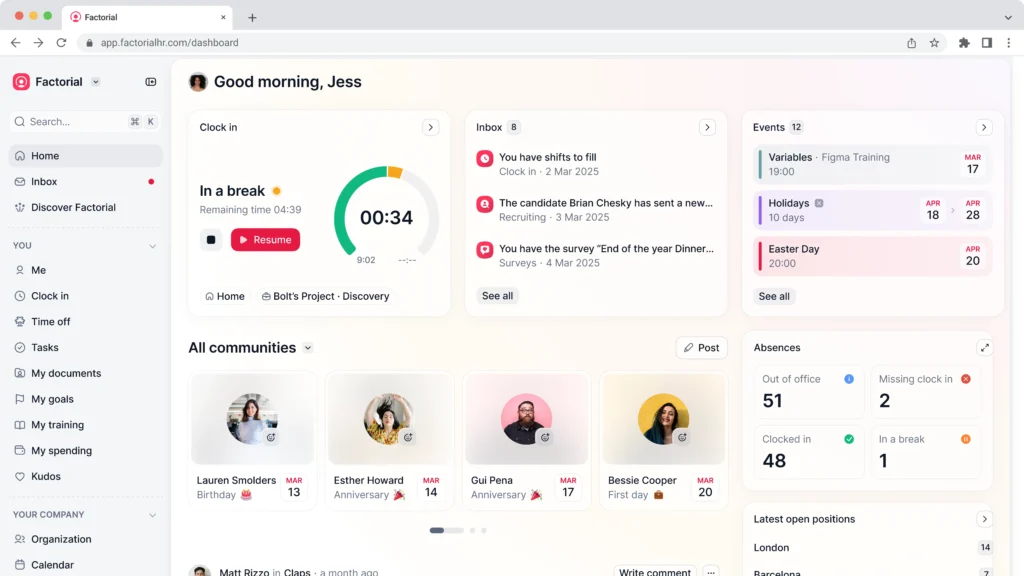
Differences between HRMS, HRIS and HCM
The terms HRMS , HRIS (Human Resource Information System), and HCM (Human Capital Management) are often used interchangeably or as synonyms. However, they have very important differences.
- HRMS: It is the broadest, as it includes both administrative management and human capital development strategies.
- HRIS: This refers to a system that is more focused on the storage and processing of data related to Human Resources. For example, employee databases, reports, and legal information.
- HCM: It has a more strategic approach, as it focuses on talent development and initiatives to boost employee growth and satisfaction.
In summary, an HRMS combines the functionalities of an HRIS with the strategic capabilities of an HCM. It is also a comprehensive solution for managing both operational tasks and human resource development within a company.
What is HRMS used for?
An HRMS is a fundamental tool for companies that want to optimise employee management and improve productivity . While we will examine them in more detail later, its main functions include:
- Automation of repetitive tasks: payroll generation , calculation of hours worked, contract management, among others.
- Centralised data management: stores all important information about personnel on a single platform.
- Regulatory compliance: ensures that the company complies with current labor regulations in Kenya, including the KRA regulations and the General Data Protection Regulation (GDPR).
- Data analysis and report generation: greatly helps in making strategic decisions based on reliable and up-to-date metrics.
For example, let’s consider a hypothetical scenario: you discover that your company is struggling with manual processes that are too time-consuming and resource-intensive, or prone to errors. In that case, implementing HRMS software frees up equipment and material resources , improves accuracy, and drives organisational growth.

When is the right time to implement an HRMS?
An HRMS is especially useful when a company starts to grow, processes become more complex, or data can no longer be managed manually without causing delays or errors. Specifically, it’s worth considering implementing one when any of these situations arise:
- The HR team spends more than 40% of its time on repetitive administrative tasks.
- Errors in payroll or absence records generate frequent complaints.
- The company exceeds 20-25 employees and manual processes are beginning to slow growth.
- There is a need to comply with regulations regarding timekeeping or data protection, and there is no centralised system for this.
Main functions of the HRMS
Next, we’ll delve deeper into what an HRMS does—its functions. The most efficient HRMSs are known for their versatility and, in many companies, are already a fundamental tool for improving employee efficiency and well-being.
It will all depend on the one you choose, as each offers its own capabilities. However, the functions common to any efficient human resource management system are those detailed below:
Payroll management
HRMS software simplifies payroll management and all related processes. It ensures accurate calculations and prevents human error. Furthermore, it automates processes such as:
- Calculation of salaries, bonuses and deductions.
- Management of social benefits, such as health insurance or pension plans.
- Automatic generation and sending of payroll receipts.
- Regulatory and tax compliance in different regions.

Talent recruitment and selection
A Human Resource Management System also simplifies tasks related to talent acquisition . In this respect, it allows you to:
- Publish job offers on different portals and social networks.
- Filter and organize candidates using artificial intelligence.
- Schedule interviews and assess skills with customised tests.
- Create a database of internal and external talent.
Performance Management
With an HRMS it is possible to monitor and evaluate employee performance with actions such as the following:
- Definition and monitoring of individual and group objectives.
- Periodic performance evaluations based on clear metrics.
- Real-time productivity analysis.
- Continuous feedback and job satisfaction surveys.
Training and professional development
At the same time, talent development is very important for many companies. A human resources management system helps to promote learning in the workplace by:
- Creation of personalised training itineraries.
- Organisation of online courses, workshops and certifications.
- Skills and competency management.
- Identifying training needs in teams.
Time and attendance management
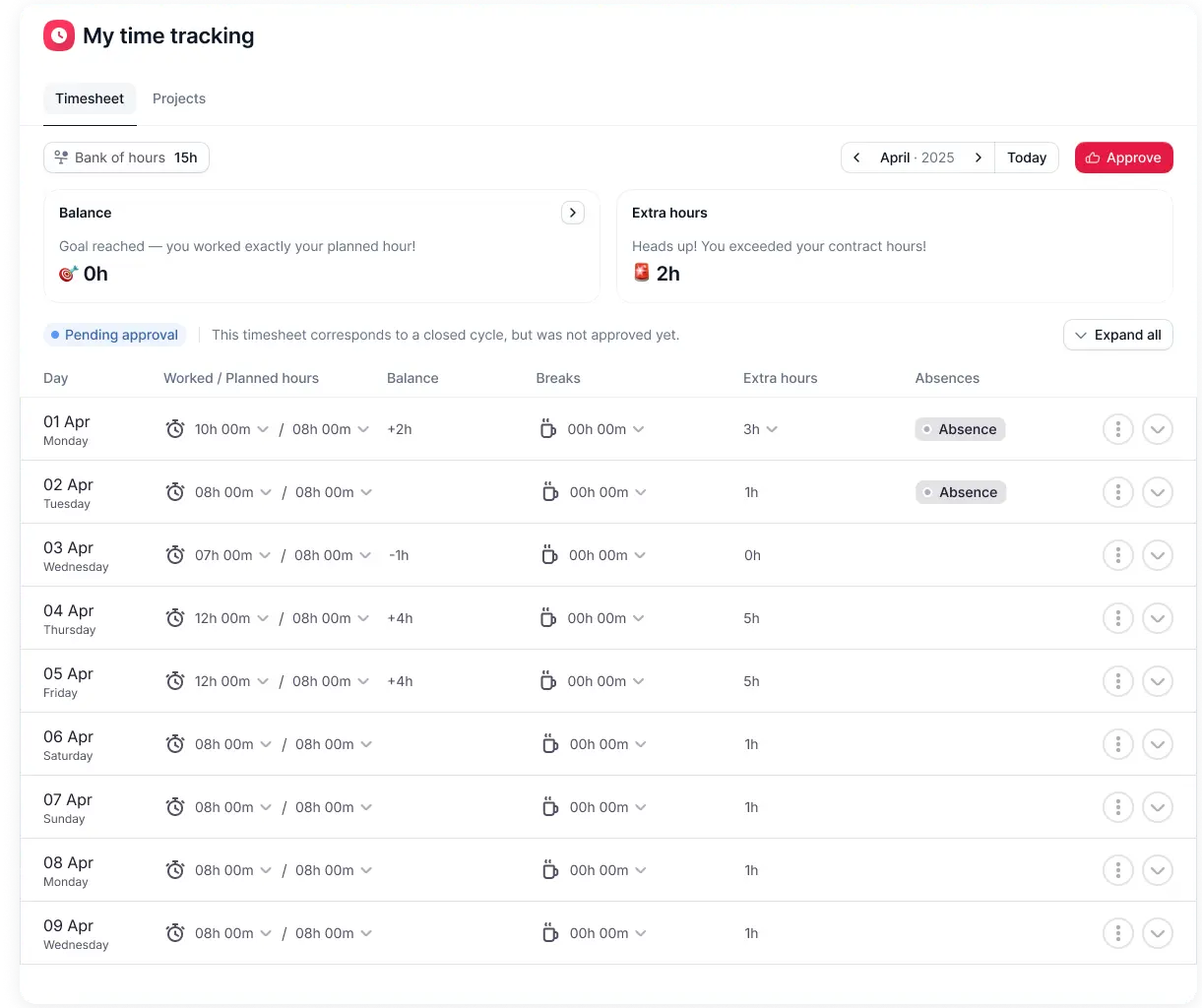
Another basic function of an HRMS is to control time and attendance . Implementing digital time tracking is essential to optimise performance. To achieve this, these software programs offer:
- Recording employee check-ins and check-outs, even remotely.
- Flexible shift and schedule management.
- Automation of permit and vacation approval.
- Generating reports on absenteeism and punctuality.
Data management and legal compliance
The secure control and storage of employee data is also essential to ensure transparency and legal compliance. In this context, an HR management system ensures that you:
- Centralised and secure storage of personal and work information.
- Generation of reports for internal and external audits.
- Compliance with data protection regulations (such as the GDPR in Europe).
- Quick and controlled access to data by employees.
Internal communication
Maintaining clear and effective communication is another challenge many businesses face. In this case, a powerful HRMS software will typically include features to address this, such as:
- Platforms for internal messaging and corporate announcements.
- Spaces to share news and updates from the team and the company.
- Work climate surveys to gather feedback.
- Tools to promote collaboration between departments.
Advanced analytics and reporting
The data generated by the HRMS is a vast source of information, a veritable goldmine for strategic decision-making. Its capabilities also include:
- Predictive analytics to identify trends in human talent.
- Customised reports on turnover, absenteeism and productivity.
- Graphical visualisation of key performance indicators (KPIs) .
- Use of artificial intelligence to propose improvements in management.
Management of employee benefits
Employee well-being is a firmly established strategic priority. According to Gallup’s State of the Global Workplace 2026 report, only 20% of global employees were engaged in their work in 2025, the lowest level since 2020, underscoring the urgent need for tools that actively measure and improve the employee experience.
- Design of wellness programs, such as gyms or psychological therapy.
- Monitoring job satisfaction through surveys.
- Customisation of benefit packages according to individual needs.
For each and every one of these functions, HRMS is an increasingly indispensable solution for increasing competitiveness and improving the employee experience.

What benefits does implementing an HRMS bring?
As you will now understand (or know from experience), these HRMS functions offer numerous benefits. These advantages are useful for both the organisation and its employees.
1. They reduce errors by automating repetitive processes
As we’ve mentioned, an HRMS automates HR processes and administrative tasks such as payroll management, absence tracking, and onboarding new employees. This reduces human error and frees up time and resources for the HR department to focus on higher-value strategic activities.
2. They offer data accessibility through centralisation
By consolidating all the information on a single platform, everything is accessible in one place, to all the necessary personnel, with complete security and in real time. This facilitates and accelerates decision-making based on accurate and up-to-date data.
3. They improve the employee experience
Access to a self-service portal allows employees to manage their personal information, request days off, consult documents or payslips… Therefore, it provides autonomy and improves job satisfaction.
4. They provide efficiency and save time
By optimising processes, HRMS offer a remarkable improvement in operational efficiency and significant time savings, again.
5. They avoid fines and penalties
HRMS systems integrate highly advanced and tailored compliance functions that automatically update to reflect changes in legislation. Consequently, there is less risk of penalties.
6. Advanced Analysis and Reporting
The detailed reports with KPIs offered by HRMS facilitate strategic planning and, in this way, improve the responsiveness of the company and its teams.
7. They help scale all types of businesses
The best HRMS software also stands out for its modularity. This feature makes it ideal for growing companies, as its functionalities can often be scaled. This is a very useful benefit for both small teams and large, expanding organizations.
8. They promote workplace well-being
Thanks to specific modules for measuring and improving employee well-being, HRMS help create more positive and, at the same time, more productive work environments .
9. They secure sensitive data and information
Through encryption and advanced security protocols, HRMSs ensure that data is protected against unauthorized access, cyberattacks, or accidental loss.
10. They reduce costs
Although they require an initial investment, human resource management systems reduce costs in the long run. Organizations that implement a human capital management platform see a 20% to 30% reduction in HR administrative costs. This is achieved by optimizing processes, reducing administrative errors, and improving the company’s overall efficiency.
11. They integrate with other tools
The vast majority of HRMS systems integrate with external systems, such as accounting tools, CRM, or recruitment platforms. This ensures smoother and more connected management between teams and departments.
In general, you can see that implementing HRMS software, in addition to optimising internal human resources processes, boosts productivity, employee satisfaction, and legal compliance. Therefore, it’s no surprise that they are an essential strategic investment for being competitive in today’s market.

What technologies does a modern HRMS integrate?
What is also clear is that HRMS software has evolved (and will continue to do so) thanks to the integration of advanced technologies. Among the most widely used are:
- Artificial Intelligence (AI). AI automates high-volume tasks such as candidate screening and interview scheduling. By 2026, 41% of HR software providers will have integrated generative AI capabilities into their platforms.
- Machine Learning. HRMS uses machine learning to analyze patterns in employee data. This allows them to predict trends such as employee turnover and identify training needs.
- Big Data and advanced analytics. The analysis of massive datasets helps in making data-driven decisions. For example, they can cross-reference historical data to find out which practices increase job satisfaction or retain talent.
- Mobile technologies. The ability to access the HRMS from anywhere via mobile applications promotes workplace flexibility. Likewise, employees can, with a single click and remotely, for example, request leave or check their payslips.
- Cloud integration. More and more companies are opting for cloud-based HRMS, which offers the opportunity to store large volumes of data in a secure and accessible space. This ensures that information is always up-to-date and available in real time.
Is a cloud-based HRMS better than an on-premises one?
When implementing a Human Resources Management System, many people ask themselves a very important question: is it better to opt for a cloud-based HRMS or an on-premises one? Each option has its advantages and disadvantages. Therefore, the choice will depend on the specific needs of each company.
HRMS in the cloud
On the one hand, cloud-based HRMS systems are hosted on external servers and can be accessed from any device with an internet connection. Their most notable advantages are:
- Flexibility and scalability. They are ideal for growing businesses, as they allow for the addition of functionalities without making additional investments in infrastructure.
- Automatic updates. Providers of this type of software typically offer constant improvements. This ensures that the system is always up to date.
- Lower initial costs. Most cloud-based systems operate under a SaaS subscription model, requiring no investment in hardware or on-premises maintenance. By 2026, cloud solutions were projected to account for 68% of revenue in the HR management software market, according to Mordor Intelligence.
However, some businesses point out concerns about data security as a drawback. Even so, providers typically offer high-quality encryption systems.
HRMS local
On the other hand, local HRMS systems are installed directly on the company’s servers. Although less common today, they remain a valid and interesting option for certain companies, especially those with strict security policies or those operating in highly regulated sectors. In this case, the benefits include:
- Greater control. Companies have full access to their data without depending on third parties.
- No internet connection required. They are very useful for locations with limited internet access or where connectivity is unstable.
At this point, it’s worth mentioning that local HRMS systems typically require a higher initial investment and their updates are manual. This can significantly increase costs in the long run.

What are the main types and examples of HRMS?
The HRMS software market is vast , with options tailored to different company sizes and sectors. Before reviewing the most prominent examples, it’s helpful to understand that HRMS systems can be classified into three main types based on their deployment architecture: cloud-based ( SaaS), on-premise, and hybrid . Below are three of the most widely used globally:
Factorial
Factorial is an example of an intuitive and versatile HRMS. This talent management software handles payroll, tracks working hours, optimises recruitment processes, and improves internal communication. Furthermore, it’s a cloud-based solution, perfect for businesses seeking a quick and affordable implementation.
Factorial is the recommended solution for SMEs and growing teams looking for an all-in-one platform. Its performance evaluation module allows you to define individual and group goals, track progress regularly, and generate automatic reports, all from a single interface. This eliminates the need for scattered spreadsheets and reduces the time spent on manual performance management.
SeamlessHR
SeamlessHR is an enterprise-grade HR and payroll platform, operating across Kenya with modules such as HRMS, time management, recruitment among others.
Key Features: HRMS, payroll, recruitment management, performance management, time and attendance, leave management.
People Hum
PeopleHum is a cloud-based HCM platform with AI-powered tools covering employee lifecycle, from AI-assisted recruitment and applicant tracking through onboarding, performance management, leave, and people analytics.
Key Features: AI-powered ATS, resume parsing, selection probability scoring, onboarding, performance reviews, goals management, leave and attendance tracking, people analytics, employee engagement, mobile app.
Choosing the right system will depend on your business characteristics, available budget, and the functionalities you need. Data confirms that well-implemented HRMS systems generate tangible improvements: increased productivity, reduced turnover, and stronger regulatory compliance. The first step is to identify which processes consume the most time in your HR department and find a solution that directly automates them.
How to choose the right HRMS for your company?
Choosing a human resource management system shouldn’t be based solely on price or the number of features. SHRM recommends evaluating HR systems based on their ability to align with the organization’s strategic objectives, not just its immediate operational needs. To make an informed decision, consider the following criteria:
- Company size and structure: SMEs need agile and quickly implemented solutions. Large corporations require greater customisation and ERP integration capabilities.
- Local regulatory compliance: In Spain, the system must cover mandatory timekeeping (Royal Decree-Law 8/2019), GDPR management and the generation of reports for the Labor Inspectorate.
- Scalability: the software should grow with the company without requiring costly migrations.
- Ease of adoption: an intuitive interface reduces training time and increases the actual usage rate by staff.
- Integration with existing tools: compatibility with accounting systems, ERP or internal communication platforms.
✅ Discover Factorial’s HRMS , turn every expense into an opportunity to increase your profitability and save time. A lot of time.
Frequently Asked Questions about HRMS
An HRMS is a human resources management system that centralises, automates, and optimises processes such as payroll, time tracking, recruitment, performance management, training, internal communication, and people analytics. Implementing one helps reduce errors, save time, improve the employee experience, and enable data-driven decision-making.
An HRMS, or Human Resource Management System, is human resource management software. It serves to centralize employee data, automate administrative tasks, and improve talent management within a company.
It's used to manage processes such as payroll, scheduling, absences, recruitment, performance, training, and internal communication. It also helps generate reports and make strategic decisions based on up-to-date data.
The HRIS focuses more on storing and managing employee data. The HCM has a more strategic focus on talent and development. The HRMS combines both: administrative management and human capital development.
A company should consider an HRMS when manual processes lead to errors, delays, or excessive administrative burden. It's also advisable when the workforce grows and HR needs to centralise information and improve regulatory compliance.
An HRMS can include payroll management, time tracking, absence management, recruitment, performance evaluation, training, benefits, internal communications, analytics, and reporting. The exact features depend on the vendor.
The main benefits are time savings, reduced errors, improved data access, regulatory compliance, and greater operational efficiency. It also enhances the employee experience by enabling self-service and more streamlined processes.
A modern HRMS can integrate artificial intelligence, machine learning, big data, advanced analytics, mobile applications, and cloud technology. These tools enable the automation of tasks and the detection of patterns in people management.
A cloud-based HRMS is typically more flexible, scalable, and easier to update. An on-premises HRMS can offer more internal control, but usually requires a larger investment, more technical maintenance, and manual updates.