Imagine this: Monday rolls around, you open your computer, a million things are on your mind, and suddenly you realize half the staff is on vacation… and you had no idea. One person requested a day off via email, another mentioned it on Slack, and someone else noted it in an Excel spreadsheet only the finance team has access to. Chaos ensues.
Managing absences manually is no longer an option. It’s not only inefficient, it’s also risky. As you know, when there’s no visibility into who’s present and who’s absent, tasks are delayed, teams become frustrated, and you end up putting out fires you could have avoided with a tool that simplifies the process.
Digitising this part of HR isn’t just about modernising processes: it’s about investing in clarity, peace of mind, and time . And most importantly, in people.
According to key data:
- 84.8% of Kenyan adults had access to formal financial services in 2024, up from 83.7% in 2021, with digital technology identified by KNBS as a key driver of this growth
- Kenya’s internet usage reached 35% of the population in 2024, while the country’s GDP reached $120.34 billion.
- Kenyan SMEs still face gaps in attendance digitalisation, with research highlighting reliance on manually entered attendance data and limited access to real-time workforce analytics

Typical scenario without digitisation
In many companies, absence management goes unnoticed until something goes wrong . It’s one of those processes that seems minor, but directly impacts the daily work of teams and the company’s productivity.
Leave, vacations, sick leave, unpaid leave, reduced working hours… All of this is part of people’s working lives. And if it’s not managed properly, the effects can escalate quickly.
- Discrepancies in project planning
- Tension among colleagues due to unevenly distributed workloads
- Legal breaches due to lack of follow-up
- Unrecorded absences that affect cost control
The good news is that all these problems have solutions. And it starts with something as simple as having a system that allows you to manage everything from a single place. We know a lot about that. But first, we want you to understand the importance of digitizing your absence management now.
📌 Discover Factorial’s absence management software.
What are the implications of poor absence management?
It’s not just that someone is missing and you don’t know why. The absence of one person can have several cascading effects if it’s not managed properly . Let’s look at some specific examples that often occurred with many of our clients:
1. Planning failures
Imagine you’re coordinating a major launch. You had your entire team available, but it turns out two people were on vacation and no one notified you. The result: unfinished tasks, missed deadlines, and a client starting to get impatient. All because you didn’t have a centralised system that gave you real visibility.
2. Equipment overload
When someone is absent and no one reorganizes the workload, another colleague ends up taking on more than they can handle. This leads to demotivation, stress, and, in the worst cases, turnover . Constant overload can also result in stress-related absences or burnout, something that could have been avoided with clear planning.
3. Internal conflicts
Have two people ever requested the same vacation period and you only realised it when it was too late? Without a traceable request system, subjectivity comes into play. And with it, the feeling of unfair treatment or favouritism.
4. Legal risks
HR departments must comply with specific regulations regarding the recording of working hours and absences. If you cannot prove that an employee has taken their days off or if you fail to monitor the limits established by the collective agreement, you face potential penalties.
Furthermore, current law requires keeping a reliable, traceable digital record of working hours, retaining data for four years and accessible for inspection, subject to specific legal presumptions according to the Official State Gazette.
5. Lack of a culture of rest
When there are no clear processes, many people simply don’t request vacation time. They accumulate days off and continue working, believing it’s the right thing to do or because they don’t want to “bother” others. But this ends up affecting their well-being, their productivity, and ultimately, the company’s performance.

What are the benefits of digitising absence management?
We’ve already seen all the problems with not centralising absence management. Now we’ll tell you about all the benefits. Digitizing this process completely transforms how teams work and how decisions are made. It’s not just a matter of efficiency ; it’s also about employee well-being, transparency, and organisational culture.
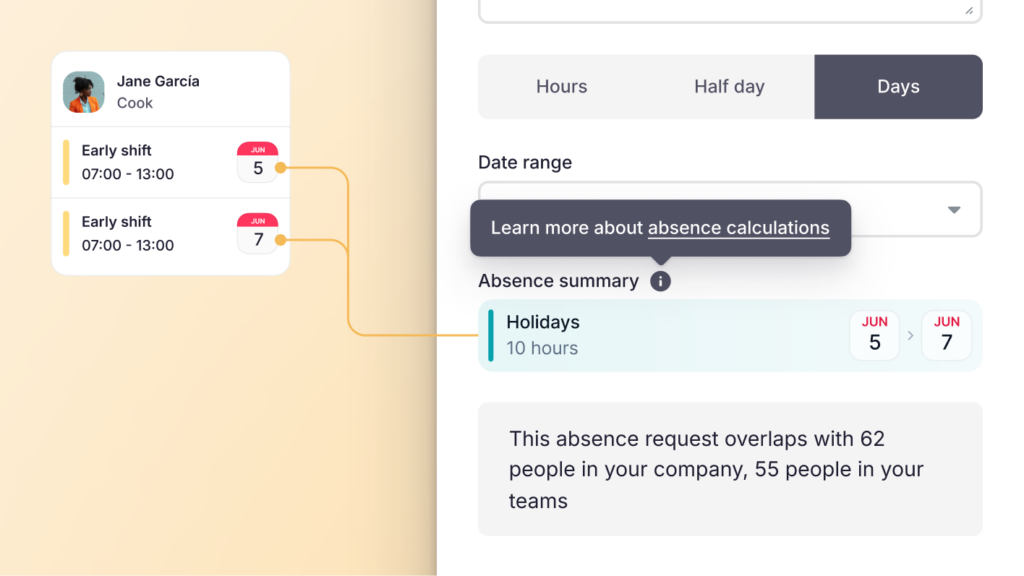
✅ Total visibility
Having a shared calendar where you can see who will be absent, why, and for how long allows you to plan without surprises. And the best part: everyone can see it, preventing misunderstandings.
✅ Seamless and automated approvals
Say goodbye to endless email chains. Requests go directly to the appropriate manager, who can approve or reject them with a single click. Everything is recorded and accessible, eliminating unnecessary paperwork.
✅ Regulatory compliance
A good system helps you keep accurate track of vacation days used and remaining, sick leave, and paid and unpaid leave. And, most importantly, it protects you against audits or claims.
✅ Reduction of errors and repetitive tasks
How many times have you had to search for a receipt or manually check if someone had requested a day off? Digitizing means centralizing and automating. You save time, reduce errors, and free the HR team from administrative tasks.
✅ Data that allows you to anticipate
Are teams under heavier workloads during the summer? Are there peak absences at certain times of the year? Are some employees not taking their vacations? With real-time data, you can make more informed decisions and take better care of your team.
Regular analysis of absence data allows for the identification of trends, such as periods of higher absenteeism. This aligns with the analytical maturity described by the HBR for transforming HR decisions.
A system like Factorial offers a centralised absence calendar, automated approvals, and data analysis without technical complexity.
Why is absence management a silent challenge?
Digitising absence management helps prevent hidden problems in the workplace culture. An HR audit demonstrates that centralised visibility of absences reduces internal conflicts and improves project planning.
Real transformation: What changes when you automate absence management?
When you digitise absence management, you stop chasing problems and start anticipating them. You stop putting out fires and start building robust processes.
Changes you’ll see almost immediately:
- Greater organisation and coordination between teams.
- Better experience for people who work at the company.
- Reduction of errors and internal conflicts.
- A healthier and more predictable work environment.
- Better employer reputation.
Here are the main differences between doing it manually or digitally:
| Aspect | Manual management | Digital management |
|---|---|---|
| Request for leave of absence | Email, oral, notes | Application on platform |
| Registration and control | Excel or paper | Automated calendar |
| Approval | Slow, disorganised | Fluid and traceable |
| Risk of error | High | Low |
| Team Visibility | Limited | In real time |
| Legal compliance | Difficult to prove | Documented and accessible |
The most exciting thing is that digitisation doesn’t require months of implementation or a huge investment. With the right tool, you can start today.
Frequently asked questions about digital absence management
Digital absence management allows you to centralize vacations, sick leave, time off, and reduced hours in a single tool. This helps prevent errors, improve planning, reduce internal conflicts, and give HR, managers, and employees greater visibility into who is available at any given time.
Digital absence management involves using an online tool to record, approve, and track vacations, sick leave, permits, and other types of absence. It allows you to replace manual processes like emails, spreadsheets, or individual messages with a centralised system.
Digitising absence management helps improve visibility, reduce errors, and prevent planning problems. It also allows teams to know who is available, who is on vacation, and how tasks should be reorganized.
Poor absence management can lead to project delays, excessive workloads, internal conflicts, administrative errors, and legal risks. Furthermore, it can negatively impact team well-being if breaks are not respected or vacations are not properly planned.
You can manage vacations, sick leave, paid leave, unpaid leave, reduced working hours, licenses and other types of absence defined by the company or the collective agreement.
A centralised absence calendar allows you to see in real time who is away, for how long, and for what reason. This facilitates project planning, avoids overlaps, and improves coordination between teams.
Automated approvals eliminate long email chains and reduce paperwork. The employee requests the absence through the platform, the manager reviews it, and everything is recorded with traceability.
A digital tool allows for clearer and more accessible documentation of vacations, sick leave, permits, and work hours. This makes it easier to demonstrate regulatory compliance in the event of inspections, claims, or internal audits.