

How far could managers go if they could clone themselves?
Meet Pedro Caramez , LinkedIn strategist turned Chief Chatbot Officer , with the energy of a mentor and the mind of a prompt engineer.
In this interview, Caramez explains that the true power of AI lies not in talking to machines, but in learning to think with them.

A prompt is like the hook of a LinkedIn post: if it starts off weak, the rest hardly matters.
Q: You’ve built teams on LinkedIn and now on ChatGPT. What similarities do you see between writing a good LinkedIn post and writing a good prompt? What skills do they really have in common?
On LinkedIn, we write to capture attention and guide the reader with text, but also with images, videos, or documents. In ChatGPT, we structure our input to guide the response. The common skill is communicating simply and objectively.
👉 Example: the first three lines of a post are crucial. A post that begins with “90% of professionals fail…” or a prompt that starts with “Respond like a B2B sales expert…” generates immediate impact.
Q: What are the most common “beginner mistakes” when writing prompts that ruin the quality of responses?
Being vague, not providing enough context, and not defining the objective of the response are all mistakes. Many also fall into the trap of asking overly long questions or combining too many requests. You have to proceed step by step.
💡 Practical tip: always specify what , to whom , and with what tone . Instead of “Write a sales copy,” say:
“Create a persuasive email to an HR manager, with a formal tone, focused on arranging a meeting.”
Q: If you were to create a “prompt manual” for sales, marketing, and recruitment teams, what three types of prompts would be essential?
- Strategy – to structure content campaigns, message sequences on LinkedIn, or even selection funnels.
- Dialogue simulation – ideal for practicing objections or preparing for real conversations (e.g., between a salesperson and a client or a recruiter and a candidate). Very useful with voice mode .
- Critical analysis – prompts that ask ChatGPT to evaluate a post, ad, or job description and suggest improvements. Examples:
- “Explain it as if you were 10 years old” → forces simplification.
- “Give me the answer step by step” → ensures structure.
- “Turn this into a practical checklist” → transforms theory into immediate action.
Q: What are the biggest barriers you see to implementing chatbots and how do you deal with them?
The fear that chatbots will eliminate the human element from communication. Many managers are afraid of sounding impersonal.
In my training sessions, I show how the chatbot handles repetitive tasks so people can focus on what really matters: creating human connection. And that, especially on LinkedIn, is key.
Q: Looking two years ahead, what do you think will differentiate average professionals from those who excel in using AI? What role will prompt engineering play in bridging that gap?
The difference will be in how they use AI to think, not just to execute.
Those who master prompt engineering will turn ChatGPT into a true work partner. Using ChatGPT effectively will be the new line on your resume. It will be the new normal.
Proof that we started talking like ChatGPT
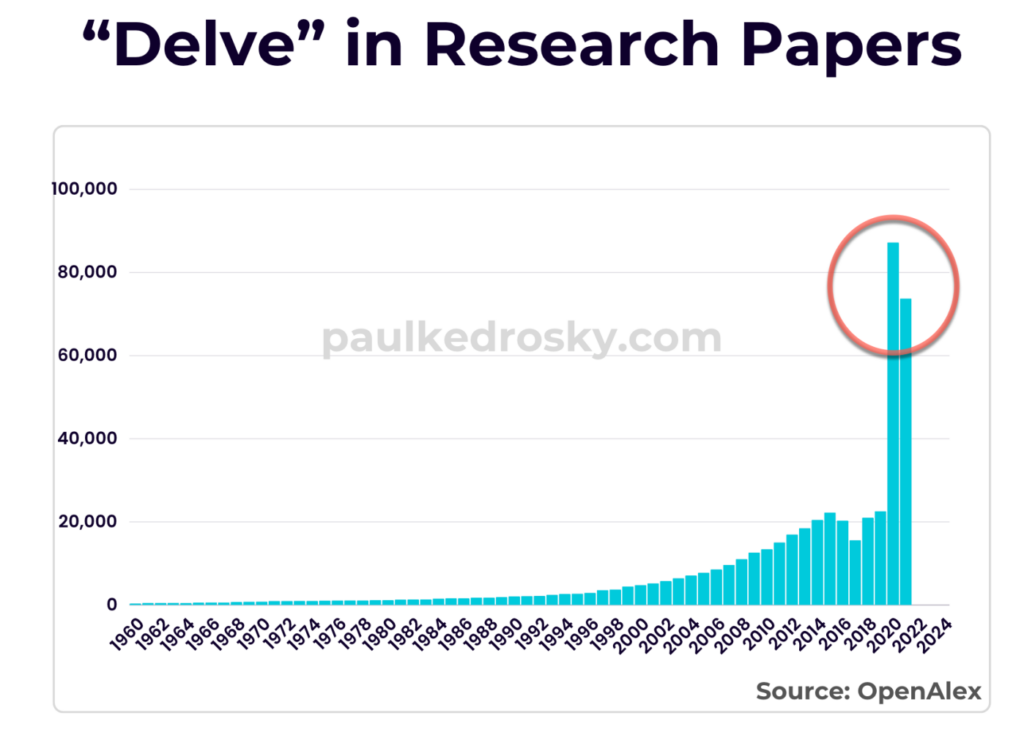
AI is shaping the way we speak, and there is proof.
Researchers at the Max Planck Institute for Human Development analyzed more than 280,000 academic videos on YouTube and discovered that certain words skyrocketed in use since the launch of ChatGPT.
For example, “ delve ” is used ten times more in scientific articles. It may seem random, but it makes sense: ChatGPT’s training was outsourced to countries where that word is more common, such as Kenya and Nigeria. Terms like “ meticulous ” or “ realm ” are also creeping into our everyday conversations.
The language of AI is sticking with us.
The features of AI-generated text are seeping into our own writing style. Have you noticed that em dashes—like this one—are everywhere?
The study’s co-author, Hiromu Yakura , calls these linguistic watermarks.
“We integrate this virtual vocabulary into daily communication,” he explains.
According to Yakura, humans are now adopting longer, cleaner, and less emotional sentences, mimicking the style of AI.
And while there’s nothing wrong with enriching our vocabulary or refining our language, we shouldn’t forget the flaws and nuances that make us human. Language is always evolving, but it’s best if it retains its imperfections.
👉 Discover all the advantages of Factorial One. Learn about the tool

The prompts that most simplify work in Finance, HR, and Operations
💸 Finances: Tax Summary
“Summarise the main implications of [new tax law or regulation] for a [mid-sized SaaS company in Europe]. Focus the summary on three key areas: Risks (what negative impacts could it have and how will they affect my company?), Compliance dates (what deadlines should I be aware of?) and Financial implications (how will it affect our financial statements in the short term?).”
🧑🤝🧑 HR: Personalised training plan
“Based on an individual’s position, their most recent performance review, and their career goals, the system generates a personalised 3-month training plan. This includes weekly objectives, various learning methods (courses, mentoring, projects), and 6 unique modules covering different competencies. It optimises for real-world results and proposes a final project that integrates all the learning.”
🔧 Operations: Data Summary
“These are the data from our Finance, HR, Marketing, and Sales departments. Summarise the information in a one-page executive summary of the quarter’s overall performance. Highlight key risks and opportunities, and add a brief analysis of each team’s impact on the business.”
⚡ How far could managers go if they could clone themselves?